Sunday, April 01, 2018

4 Types of Blockchain


One of the questions I commonly get asked is what is the difference between public and private blockchains. It is easy to see why people get confused as public and private blockchains have many similarities.
  • Both are decentralized peer-to-peer networks, where each participant maintains a replica of a shared append-only ledger of digitally signed transactions.
  • Both maintain the replicas in sync through a protocol referred to as consensus.
  • Both provide certain guarantees on the immutability of the ledger, even when some participants are faulty or malicious.
There are two other types of blockchain networks being introduced – consortium and semi-private blockchains.
Examples of semi-private blockchains could include ones for government entities for record-keeping, land titles, public records, etc.

Advantages

  • Launching a semi-private blockchain more closely resembles how a company runs a website.
  • The business case is typically well planned ahead of implementation, and supports existing business, thus lowering the risk of failure.
  • Companies can more easily integrate blockchain features into this article, I will provide a short explanation on how each blockchain network works, along with what are the advantages of each network.

CONSORTIUM BLOCKCHAINS

A consortium blockchain is a blockchain where the consensus process is controlled by a pre-selected set of nodes, for example, a consortium of 15 financial institutions, each of which operates a node and of which 10 must sign every block in order for the block to be valid. The right to read the blockchain may be public, or restricted to the participants. Some examples of consortium blockchains include R3 (banks) and EWF (Energy). Consortium blockchains are also referred to as federated blockchains.

Advantages

  • Reduces transaction costs and data redundancies
  • Replaces legacy systems, simplifying document handling and getting rid of semi manual compliance mechanisms


PUBLIC BLOCKCHAINS

A public blockchain is a blockchain that anyone in the world can read, send transactions too and expect to see them included if they are valid, and anyone can participate in the consensus process – the process for determining what blocks get added to the chain and what the current stat is.  

Public blockchains are secured by cryptoeconomics – the combination of economic incentives and cryptographic verification using mechanisms such as proof of work (Bitcoin) or proof of stake (Ethereum). These blockchains are generally considered to be “fully decentralized.” One of the drawbacks is the substantial amount of computational power necessary to maintain a distributed ledger at a large scale.

Advantages

  • Public blockchains provide a way to protect the users of an application from the developers, establishing there are certain things that even the developers of an application have no authority to do.
  • Because public blockchains are open, they are likely to be used by very many entities, with no third-party verification necessary.

PRIVATE BLOCKCHAINS

A fully private blockchain is a blockchain where write permissions are kept to one organization. Read permissions may be public or restricted to certain participants.

Advantages

  • The consortium or company running a private blockchain can easily change the rules of a blockchain, revert transactions, modify balances, etc.  For example, in some case, such as national land registries, this functionality is necessary.
  • The validators are known, so any risk of a 51% attack from some miner collusion does not apply.
  • Transactions are cheaper, since they only need to be verified by a few nodes that can be trusted to have very high processing power with no need to be verified by 10,000 nodes.
  • Since read permissions are restricted, private blockchains provide a greater level of privacy.

SEMI PRIVATE BLOCKCHAINS

Semi-private blockchains are run by a single company who grants access to any user who qualifies, and they typically target business-to-business users. They will be similarly managed as a company would manage private web applications.

  • ir own back-end and meld it with a familiar web interface.

Tuesday, March 20, 2018

Trends & Challenges : Conversational Banking


Three Trends Impacting Growth of Conversational Banking

According to Accenture, three trends are coming together to support the transition from transactions to interactions.
  1. Messaging is now the preferred method of interaction: WhatsApp, Facebook Messenger, WeChat, Telegram, Snapchat, etc. have overtaken social media as the preferred way of communication on mobile devices. They are both simple and intuitive, leveraging text or voice-based interfaces. These apps also are AI-ready, offering easy integration with chatbots and cognitive agents.
  2. AI is now accessible to all organizations: The decreased cost of data storage, analytic tools and development in machine learning and deep learning enables the automation of repetitive customer support tasks, and lower level advisory services. Over time, AI will enable more advanced interactions at even lower costs.
  3. Mass personalization is now possible: The intersection of big data, advanced analytics, and predictive models is enabling personalization at a mass level. This supports vastly improved consumer experiences while increasing expectations of all financial services providers based on the delivery of services across industries.

Challenges to Transitioning to Conversational Banking

There are already more than 33,000 bots on Facebook Messenger and more than 100,000 bots offered by Chinese digital giant WeChat. These bots offer customer support, e-commerce guidance and other interactive experiences.


While a good first step, most bots today have limited capabilities. Some simply replicate already outdated FAQ experience, while others simply replace low level human-based customer service capabilities. The ultimate goal is to move more interactions to voice, supporting sales, advanced customer care and advice, with greater personalization, a better UI, less friction and more automation.

This is a unique example where the technology and consumer acceptance is already out there, but strong use cases have yet to come. Many voice capabilities have had initial success, only to have growth stalled due to lack of value-added capabilities or consumer education. Organizations will need to use education and value-added benefits to ‘sell’ them on new ways of interaction. Without education and consumer-centric benefits, it’s unlikely consumers will use a chatbot, let alone digital assistants as opposed to current human channels.

Another barrier to transition to conversational engagement is the siloed nature of banking. Conversations interactions will not move forward if the experience is not seamless, with all insights, from all areas of the organizations arranged around the consumer. Traditional segmentation or product ownership silos will only inhibit natural and successful dialogue.

Conversational Banking Strategy


Six Keys to a Successful Conversational Banking Strategy

When building a strategy for conversational banking there are six components Accenture believes are necessary for success. Many will require a complete restructuring of current back-office processes, whil others are less daunting.
  1. Acquire Needed Talent: Advanced capabilities and skills including neuro-linguists, voice recognition experts, AI developers, and CUI designers are some of those most in demand today. Talent will continue to be a barrier for many years as demand is far outstripping supply.
  2. Understand Technologies: Understanding and acquiring new technologies will require a move to real-time back-office processing and ongoing monitoring of advances in text and voice-based technology.
  3. Improved Privacy and Security: The collection and application of expanded consumer insights requires a greater focus on securing this insight. Voice biometrics will also need to be utilized for conversational interfaces.
  4. Transparency: As chatbots and conversation interfaces better replicate human interactions, it will become more important to let consumers know they are interacting with new technology … and not a human.
  5. Consistency Across Channels: It will be important to allow for consistent experiences across channels. Selection of what channels to support may revolve around security as much as anything.
  6. Consider a Hybrid Model: Since AI-based interactions are not perfect and a great deal of testing will still be required with conversational interfaces, a hybrid model including technology and humans is recommended.


Banks Are Disrupting Payments – Two International Models

1) Open model - where banks build and control the processing infrastructure, but leave the front-end competition to the market.


2) Where banks are uniting into consortiums to control both parts of the business, processing and user interface, through their own solutions.


Modular framework (central banks are offering robust infrastructure)

Among the most impressive machines falling into the first model is China’s Internet Banking Payment System (IBPS), a part of an established second-generation payment system developed by the People’s Bank of China.


“IBPS connects the online banking systems of the various commercial banks. Payments between banks can be received in near real time, with acknowledgments within 20 seconds.


China offers credit transfers (push payments) and considers direct debits are considered as pull payments. IBPS is ISO 20002-based and is the latest service to operate on the foundation of the China National Advanced Payment System (CNAPS II) interbank clearing platform.


Over recent years, the use of IBPS has skyrocketed. By the end of 2016, there were 195 institutions with direct access to the online payment interbank clearing system. In 2016, the internet interbank settlement systems handled around 4.453 billion payments to the tune of about 37.46 trillion yuan. This represents a growth of over 50% in volume and 35% in value.”


FIS reports that going forward, the expectations are that banks and more interestingly third-party organizations will develop new and innovative products & services on top of the IBPS platform, leading to higher market penetration and dominance.


China’s IBPS is reminiscent of the NPCI UPI model, where the state builds a universal infrastructure, seamlessly powering payments across both sides of the industry – banks and compliant third-parties.


UPI is a platform designed for the mobile age that helps with easy integration of various payment platforms. UPI is powered by a single payment API and a set of supporting APIs. It has a fantastic value proposition including a simple authentication process, simple issuance & acquiring infrastructure, national interoperability, and more.


UPI has reshaped entity-entity relationships (whatever entities those are – merchants, payment gateways, banks, network owners).


As Harshil Mathur, Co-founder & CEO of Razorpay, explained, “…instead of having to build 57 bank relationships a gateway has to build right now, it needs to build only one relationship with the UPI. So it will ease our efforts and help out the merchant.”


Australia’s NPP is also a very important example of how institutions are redefining payments framework on a national level.


As described by Nathan Lynch, Regional Bureau Chief, APAC, Financial Crime & Risk – Thomson Reuters, the Reserve Bank of Australia had insisted that the NPP platform be designed using a distributed layered architecture. This meant the system would be divided into a Basic Infrastructure (BI) layer and have a range of Overlay Services (OS) that could sit on top, allowing innovation and flexibility at the user interface level.
“The BI consists of distributed connectivity points (banks), message flows, a switch, a fast settlement service, and an addressing service. The OS, meanwhile, promises to allow NPP participants, approved third parties and “FinTechs” to develop payment services that sit on top of the basic layer. This forward-looking design means the platform can evolve while the underlying architecture remains stable.”

Infrastructure + front-end competition with proprietary solutions

The second model is a bit more radical than the first one: bank-owned front-end as opposed to the back-end infrastructure (or, in other words, the modular model).


There is one well-known – Zelle in the US – and another one that just made its debut in the news – Japan’s MoneyTap.


This Monday, Ripple announced that the Japan Bank Consortium (comprised of 61 banks covering more than 80% of all banking assets in Japan) will release a smartphone application called “MoneyTap” – powered by Ripple’s blockchain technology – to allow customers of the bank consortium to settle transactions instantly, 24/7. MoneyTap is the first mobile app of its kind to be developed and used by multiple banks in the country.


Three members of the Japan bank consortium: SBI Net Sumishin Bank, Suruga Bank, and Resona Bank will be the first to go live on the mobile app in autumn of 2018. This will be followed by a staggered roll out to the rest of consortium.


MoneyTap allows the bank consortium customers to make instant domestic payments and only requires a bank account, phone number, or QR code. What’s more, Ripple shares, MoneyTap helps shed the costs associated with existing banking and ATM fees that are currently applied to domestic money transfers in Japan, making those payments not just faster, but cheaper overall.
Zelle is the US equivalent of what Japan is doing.


In 2011, Bank of America, Wells Fargo, and JPMorgan Chase teamed up to work on a digital payments solution that would allow their customers to send money to each other.


The first product they developed, with the help of bank-owned company Early Warning, was called clearXchange. The solution was officially rebranded as Zelle in June 2017, with an emphasis on bringing as many financial institutions onboard as possible.


Under the covers, Zelle still functions by combining a directory of emails and phone numbers matched to bank account data along network rules for moving money along the ACH network. Thanks to bank agreements, the money is made available immediately to the receiving user, despite the overnight timing of the actual money movement.


With eventual cooperation from more than 30 of the leading financial institutions in the United States and the world, Zelle is successfully gaining ground. About $1.5 billion worth of payments were processed through Zelle just in October 2017, which is up 90% from the same month last year. At that time, Zelle counted 2.5 million active users, with thousands more signing on every day. At the end of Q3 2017, BofA had 23.6 million active users of its mobile app. The volume of mobile check deposits made on the app corresponds to the work of 1,100 branches.


There are significantly many more examples we could cover – variations of those models and their mix exist across a large number of jurisdictions. But all of this to make an important observation – banks are taking full control over payments. Here is why it’s important: the reality is that financial institutions in developed economies service a large part of the national population, and in economies with a significant number of underbanked, they are looking to offer the easiest way to get plugged into the world of digital financial services. Both models have their advantages and challenges for different types of economies, but one thing is clear – they are run or majorly controlled by banks, not by startups or processors. 

Tuesday, December 26, 2017

Why PSD2 will make it possible for customers to build their own banks - CRO FROM MONEY CLOUD

ONE OF THE BEST ARTICLE WHICH I COME ACROSS

2018 is going to be the year that permanently changes the way we see, and the way we use banks. Banks in their traditional form are going to start to disappear, and be replaced by what is known as banking technology – which is a completely different beast.

The Revised Payment Service Directive, or PSD2 as it more commonly called, is set to come into force at the beginning of next year, and “gamechanger” barely begins to describe the effect this new set of regulations governing the use of banking data will have.


PSD2 will oblige banks to give third party providers access to their customer’s accounts using Application Programming Interfaces, or APIs.

Using simple call and response technology, any firm will be able to compete tooth and nail with major banks across the same suite of services – but in the main, two new types of agent will be created.

Firstly, AISPs – Account Information Service Providers. These types of agents are service providers who have access to banks customers’ account information. This will allow them to provide customers with aggregated data from all of their various accounts, keep track of their spending, and use the data they collect to make recommendations about how best users can manage their money.

Secondly, PISPs – Payment Initiation Service Providers – PISPs are able to initiate payments on behalf of their users; allowing them to pay friends, or bills, or move money abroad, or shop at brick and mortar stores or online stores, in a wide variety of different ways.

We have already seen disruptive AISP and PISP services emerge and threaten the big banks’ hegemony over services such as Direct Debits, money transfer, customer product recommendations and real-time information (e.g. balance statements or overdraft alerts) supplied via open APIs.

But when PSD2 becomes law, the playing field will not only be levelled, it will be the banks that will be forced onto the back foot.

The banks’ labour-intensive sets of systems and controls will put them at a disadvantage when compared to smaller, more agile service providers which use only the latest technology and have no “legacy” infrastructure to replace or update.

Banks are also likely to lose the “PR War” too; their products and services have been unpopular and mistrusted ever since the global financial collapse of 2008, whereas modern fintech firms are unsullied by what has gone before and receive favourable press, as well as plenty of encouragement from their venture capitalist backers.

But it is not all bad news for banks. Firstly, they have a major advantage over the “challenger” fintech firms in that they have huge existing customer bases – they need only get their post PSD2 services right and it will be easier for them to persuade customers to stick with them rather than transfer their business to a newer, greener service.

Secondly, and somewhat ironically, some of the most successful fintech startups are, in fact, funded by the big banks. Take Atom Bank, which recently received an £83m venture round investment from Banco Bilbao Vizcaya Argentaria, BBVA, one of Spain’s biggest banks.

Or Starling Bank; run by an ex-banker, and backed by a hedge fund manager, with ex bankers and ex Financial Conduct Authority big-wigs on the board.

But from the customer’s perspective, the real difference will be experienced via the PISPs. It is the payments industry that is really set to change the face of the modern banking industry.

The biggest difference will be that payment card usage will drop – by between 9-40%, depending on your source. Eventually, payment cards may be phased out altogether.

Mobile payments, payments using wearables, payments using any Internet of Things connected devices, payments across messaging services, payments over social media. All of these services, possible already, will begin to come even more to the fore.

It isn’t hard to see big tech companies steal market share away from big banks through more agile payments services. PSD2 makes it possible for almost any firm; Apple, Facebook, even SnapChat; to act like a bank and offer the same services – but it does not work the other way.

Natwest, Santander, Barclays are not going to launch hugely popular social media platforms anytime soon – although don’t be surprised if they try – it represents their best chance of staying relevant to their invaluable Millennial customers.

But to return to the point in the title of this post, it should be customers who are most excited about this obscure regulation, PSD2, they have probably never heard of.

It gives customers’ choices galore, and significantly empowers them. For example, a merchant that pays lower fees for processing Apple Pay transactions will be desperate for customers to pay this way, and will try to entice customers to do so.

Or, challenger banks keen to wrestle customers off of big banks will offer too-good-to-be-true sign-up terms. The market for loans will become more competitive. It will become easier to open a new account. Money transfer will become fee-free and immediate.

And customers will be able to pick and choose the services they want – in effect, they will be able to construct their own banks, and maintain a transparent, real-time view of all their different accounts thanks to PSD2.

Overwhelmingly, it is the customer that has the power. They can ask any service provider, for any service, and they will get it – with bells on! They can build their own bespoke suite of services and be the masters of all the accounts they survey, chopping and changing to find the best value at the click of a mouse, or swipe of a screen. It is a future that is tantalisingly close.

And we haven’t even mentioned the blockchain and digital currencies!

The EU decided to push through PSD2 in response to the failings of the first Payments Services Directive, which many observers felt didn’t go far enough in democratising the powers of big banks.
The European Commission, via PSD2, has demonstrated that it wants to achieve 3 major goals. Improve innovation, protect customers better and make internet payments and online accounts access more secure.

But it may well be the customer who has the final word.

Huw Jenkins is CTO of The Money Cloud; Huw has been working in the FX industry, helping to accurately compare the price of sending money overseas offered by different agents and services for over 12 years. At The Money Cloud, Huw and the team are building a holistic platform from which users will be able to access all of their financial accounts, send money overseas, and apply for new products and services in just a few clicks.

Instant payments: US TCH & SCT Inst launch, but are banks ready?

The launch of The Clearing House (TCH) real-time payments (RTP) platform in the US and of Europe’s SCT Inst scheme is an indication that instant payments are at last going global, but how ready are banks?

The first new payment and clearing infrastructure in over 40 years is now operational in the US after TCH RTP had its first test on 13 November when $3.50 was moved between BNY Mellon and US Bank, prompting the latter’s CEO, Andy Cecere, to say in a statement how “excited” he was.
His counterpart at BNY Mellon, Ian Stewart, hailed it as “one of the most important payment transformation efforts in our industry”. Further transactions have since run involving Citi, J.P. Morgan, PNC and SunTrust, among other early adopters as the system ramps up.


However, the RTP platform is not expected to reach ubiquity until 2020. TCH hopes that ‘by the end of 2018 half of all American depositors will have access to the system’ as the big banks migrate to it. Connecting to the core, integrating and aligning it with internal financial crime compliance activities won’t be easy for banks. But 2020 is a long time to make American consumers and corporates wait for instant payments (IP).


Large processing firms, such as Fiserv and others, are expected to serve the connectivity and processing needs of smaller US banks, credit unions and others that lack the scale or budget to execute their own migration project, but the wait will still be frustrating.


RTP supports fast, irrevocable IP, standardised messaging and data carrying capabilities in the US, which mean new services and functionality such as mobile phone number initiation, liquidity and payment monitoring services should be possible in the future.


The technology was supplied by MasterCard-owned VocaLink and the system built with the collaborative effort of TCH’s 25 owner banks, but it is open to all US depository institutions.
RTP adheres to the objectives of the US Federal Reserve (Fed) Faster Payments Task Force, effectively the scheme overseer, giving the country the chance to finally catch up with other more advanced real-time nations such as Denmark, Singapore and so on but only if banks connect to it.


Europe
European regulators, its central bank and payment service providers (PSPs) are also hopeful of speeding up euro payments. The continent’s new single euro payments area (SEPA) instant credit transfer (SCT Inst) scheme will enable fast euro-denominated payments and new services to be rolled out. Various SCT Inst-compliant clearing and settlement mechanisms (CSMs) are slowly proliferating across the continent.


Nine CSMs, such as France’s Stet automated clearing house (ACH) and Equens Worldline, declared their adherence to the voluntary SCT Inst scheme upon its launch on 21 November, but many more still need to follow.


EBA Clearing’s RT1 platform will initially provide much of the pan-European cross-border ‘reachability’ allowing instant payments to be made across the continent. Often this will be via a cross-border partnership, as in the case of Spain’s Iberpay where the ACH will handle domestic SCT Inst-compliant payments itself but use RT1 to reach far-flung corners of Europe.


The banks are lagging behind too. The European Payments Council (EPC), which designed the voluntary scheme rulebook, said 585 PSPs – only 15% of the total in Europe – were offering instant euro payment services on the launch date, across eight countries from Austria to Estonia, Italy to Spain. A lot of the initial volume was from RT1.


The slow uptake means there are a lot of banks and alternative PSPs that still to adhere to the SCT Inst scheme. In common with its US counterpart, the EPC is not envisaging full uptake anytime soon either. It is predicting PSP uptake will only reach 50% by 2020 following the non-mandatory launch on 21 November. Perhaps it should be made mandatory to speed things up?


SCT Inst is intended to reach the 34 SEPA Countries in Europe including Poland, France, UK and so on. It will encourage adoption of the ISO20022 messaging standard and give its users the ability to:
  • Move up to 15,000 euros from one account in Europe to another. The limit may rise later.
  • Maximum of ten seconds allowed.
  • Operate on a constant 24×7 basis.
It shares the fast settlement and 24×7 operational stance of its US TCH equivalent and other IP schemes around the world. Australia, for instance, has its own similar new payment platform (NPP) planned for 2018.


Numbers in Europe should pick up when large German banks, with the biggest euro flows, move fully next summer to the SCT Inst scheme. For now, a lot of smaller German and other nation’s banks have moved, but the volume figures need more Tier 1 banks to migrate to radically increase uptake.


It is not an easy task to migrate to an IP scheme – whether in the US, EU, Australia or wherever – but if banks want to retain payment volume, customers and the capacity to offer value-adding mobile or liquidity services on new infrastructures then they need to move quickly. Otherwise, alternative PSPs may look to take advantage of these new platforms themselves, where permitted, and to win flow for themselves.

Monday, December 04, 2017

Virtual Card

When it comes to payments in the B2B world, customers are looking for more convenient ways to pay their bills. With the latest technological advancements, their options are expanding. As with any new technology, however, new challenges arrive that can slow down the invoice-to-cash process. But if a supplier has the right A/R process in place, new technology doesn’t have to mean that there will be new challenges to overcome.

Virtual cards, also known as Single-Use Accounts (SUA), are among the latest in payments technologies. They are auto-generated credit card numbers that A/P departments can send to suppliers as a link contained in an email, for a one-time-use payment. Their growing popularity with customers is due to a variety of factors.


One reason is that virtual cards provide A/P departments visibility and control over the buyer’s payments. Another reason is that they automate the account reconciliation process – the more automated the process, the less chance for human error. Additionally, there is an increased level of security on the payments side. We’ve already discussed that virtual cards have a one-time use, randomly generated number. But they can also be set to the exact cost of the bill and can be set to expire after a specific amount of time, reducing the chance of theft or fraud.


On the flip side, this emerging payment process introduces new challenges for the suppliers and the A/R side of the invoice-to-cash process:
  • Processes inefficiencies
One challenge is that the infrastructure that supports virtual card payments does not currently integrate neatly with ERP systems to enable straight-through processing. In addition, while the issuing of a single-use number is automated, the supplier processing side of it is not. Consequently, A/R departments receiving virtual card payments often have to manually retrieve the card number and remittance information, process the payment and then manually apply the cash into their ERP system.
  • Interchange fees
If a supplier is given a virtual card number for payment, this will often require them to pay an interchange fee on each transaction that is completed. While these interchange fees can differ based on the type of card used, fees can get expensive, costing suppliers an average of 2.5% of the payment per transaction.
  • Security gaps
While the A/P department may start using virtual cards due to its improved security, on the A/R side, there can actually be some increased security risks. A company receiving credit card payments, for example, needs to be PCI-compliant, which means they need to comply with Payment Card Industry (PCI) Data Security Standard (DSS) in order to host credit card data securely with a hosting provider.
Additionally, while buyers may have a secure system to send the virtual card payment email, the supplier’s email may not be as secure. Ensuring appropriate security protocols can be costly for many suppliers and can open up businesses to data breach risks.

The future of virtual card payments

Despite its challenges, virtual card payments are not going away. In fact, their usage is growing almost 10% annually. By 2021, virtual card spending is expected to surpass that of traditional purchasing cards and checks. And as we are seeing that increase in the volume of emailed virtual card payments, we are also seeing further strains being put on businesses’ A/R departments.
But that strain can be relieved if the A/R department implements its own automated solution to process those virtual card payments. A part of that solution should include a comprehensive electronic invoice presentment and payment (EIPP) portal. A good portal will give A/R teams the ability to completely automate the payments process, and that includes virtual card payments.


When searching for an EIPP portal, suppliers should find one that can accept payments, generate the payment file, easily integrate with their ERP and then automatically close out each invoice as it is paid. Additionally, it should be PCI-compliant and should incorporate the highest security standards and latest encryption technologies.

Diagram: How Virtual Card Capture works


While virtual cards are not yet mainstream today, they are projected to become commonplace in the near future. As companies utilize more automation in their businesses, virtual cards will be a natural part of the B2B payment process. The ability to handle this payment process seamlessly will result in more predictable cash flow and higher customer satisfaction

Tuesday, October 03, 2017

PSD2 - How banks can save the banks?


With the activation of PSD2 regulation beginning in January 2018 for all EU countries, third parties will get access to financial data of banking customers under the condition that those customers gave their explicit consent.  While this new legislation will open up the payment space for new Third Party Providers (TPPs) such as Payment Initiation Service Providers (PISPs) and Account Information Service Providers (AISPs), and as such create an increased competition for payments services traditionally offered by banks, PSD2 will also create new opportunities for corporates and retailers.
While PISPs and AISPs will focus on gaining marketshare from the banks, retailers and corporates expect to be able to enhance loyalty, customer experience and client satisfaction thanks to this disrupting regulation.
In today's world, consumers are increasingly looking for omni-channel experiences and more relevant loyalty rewards, so the new opportunities, that the consumer centric European legislation is unlocking, are very much welcome in the current climate.
Will these be seized primarily by the well renowned Over the Top players, free from any legacy technical burden and thanks to their immense user communities, leaving banks watching their disintermediation nightmare unfold?
How will the landscape for financial services change?Retailers are very much challenged by the change in buyers’ behaviour. Consumers are increasingly demanding, everything needs to go faster, easier and more efficiently. Convenience is becoming the new loyalty driver and the consumer is sitting in the driver’s seat. Competition in the retail space is huge; for banks and other payment service providers to deal with the increasing consumer demands it is imperative to analyse in which areas to invest and in which areas to slow down. Due to the complexitiy and increasing speed of change, the availability of data analytics and the ability to make smart use of the same becomes crucial to enable the right decisions.This is one of the reasons why PSD2 regulation is not to be seen as a pure threat to banks’ market shares in payments. Banks’ applications sit on huge data vaults, so banks are in a unique position to re-think and enhance their services, helping corporate and retail customers to derive value from their financial information. In addition, an entirely new market segment arises for Banks to address: this is composed of TPPs developing new ways to use account and transaction info, building on top of banks’ data and infrastructures.An immediate benefit this revolutionised ecosystem can obtain as a whole, is an improved risk management: based on collected and interrelated data, both retailers and other TPPs (with approval from the consumer) can gain much better insights in the financial stability of consumers and/or providers, provided that banks lead the way to secure and trusted data sharing in the new “Banking as a Service” paradigm.
Open Banking: The step forward
No doubt, PSD2 presents significant opportunities for banks to create new revenue streams, increase customer ownership and innovate the bank-customer ecosystem.
However, banks will have to face a number of challenges before being able to effectively position themselves in this new ecosystem.
Through mandated 'Open Banking APIs', data such as account information, account balances and historical transaction data will become available for external parties.
Third Party Payment Service Providers (TPPs) will be able to offer Payment Initiation Services (PIS) to initiate payments on behalf of consumers, as well as Confirmations of Availability of Funds (CAF) to check account balances in case of card payments.
And the interesting thing to consider is that fintechs, businesses, retailers and ultimately the banks themselves wishing to become a TPP can do so in the new PSD2 world.Through Open Banking APIs, Banks will have the possibility to offer new value added services to their old and new customers with a managed and monetizable approach. 
Co-opetition can save the banks from wasting time and money
“Banking as a platform” is a very promising concept, but complex to achieve on an individual level by a single PSP.
One of the biggest challenges that banks face is in fact the lack of a unified technical standard for APIs interfacing both PISPs and AISPs. A proliferation of standardisation initiatives by closed communities at domestic and regional level is already visible on the market, driving interoperability issues at their highest end.
On top of this, the European Banking Authority (EBA), appointed by the EU legislator to develop the PSD2 regulatory technical standards (RTS) on strong customer authentication (SCA) and secure communication, is facing continuous resistance by market stakeholders arguing that the proposed framework could hinder the goal of a level playing field among market players. Lobby and pressure from the industry might bring to looser or even more complex requirements in the future, which leads many PSPs to opt for a wait and see approach.
To avoid losing time-to-market and making iterative investments that chase regulatory changes, common architectures and business API frameworks offered in a community-centric business model, can be a way to accelerate in the right direction.
Banks/PSPs must leverage on their ability and experience in working cooperatively, designing and agreeing on projects where “co-opetition” is key.
Fintech companies with a deep understanding and a flexible product portfolio in both cards and non-card payments, as well as a long track record interfacing interbank infrastructures and regulatory compliance, are best positioned to help Payment Service Providers and their processors/service centres adopt a layered and progressive approach to the Open Banking economy.          

4 CRITICAL DIMENSIONS OF DIGITAL TRANSFORMATION


Barclaycard - 10 years of Innovation


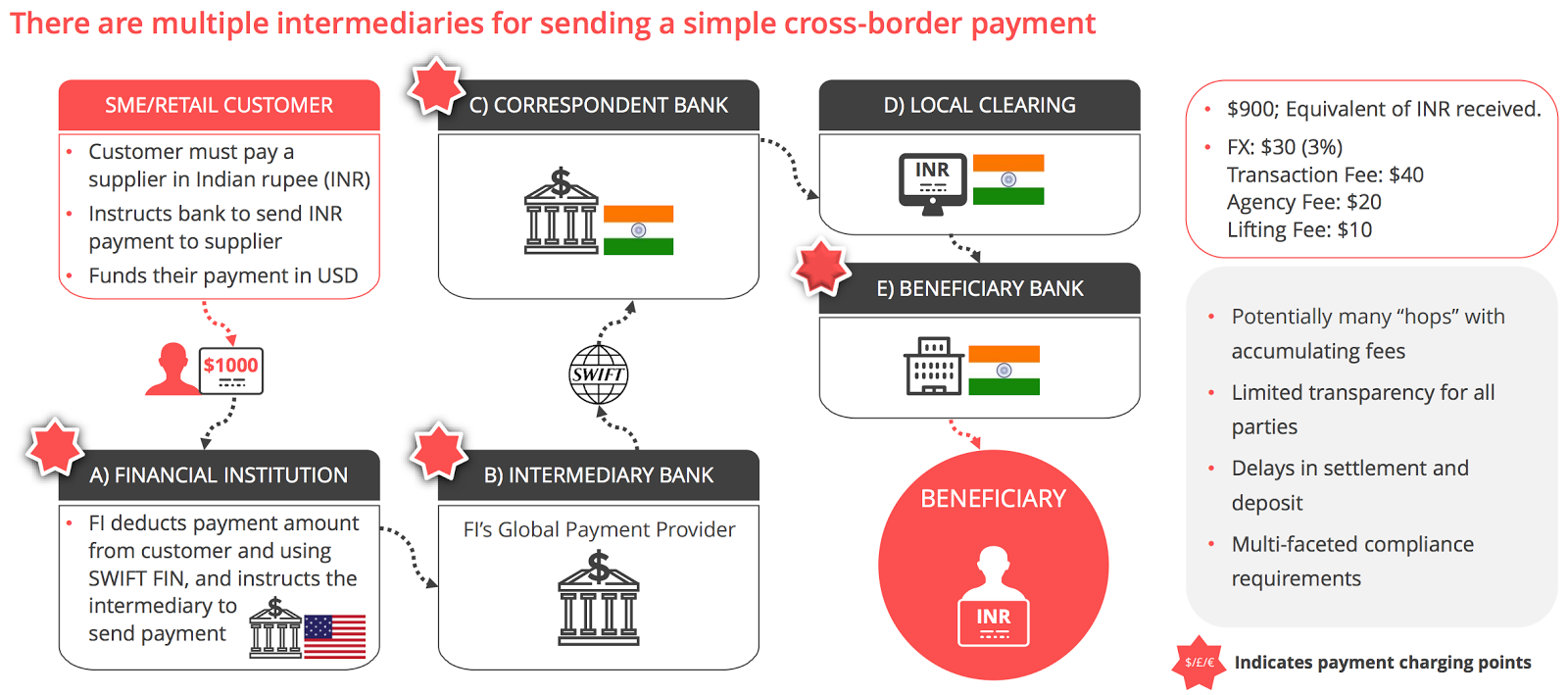
How is the International Payments Happening between US and India?


What makes the traditional system ineffective? The above diagram shows the issue in the current Banking system.

Correspondent banking forms the core of international payments via wire transfer.

All the correspondent banking relationships are impacted by changing regulations. Such relationships are being withdrawn across many geographies, causing a restricted access to financial services for a section of customers and business lines.

I believe that bank-FinTech partnerships are the defining trend for the future of international payments. With their advanced technological leverage and innovative solutions, FinTech can fill the gaps and enable banks to provide efficient, high-speed and low-cost international payment services to their customers, while improving banks’ profit margins and running a sustainable business.

Sunday, June 04, 2017

Mastercard PayPass

PayPass is a Mastercard Global Contactless payment Brand.


PayPass must be implemented using approved Chip Applicaitons, for example :
  - PayPass - M/Chip 4
  - PayPass - M/Chip Flex
  - M/Chip Advance
  - Mobile Mastercard PayPass - M/Chip 4
PayPass - M/Chip 4
- Extension of the M/Chip 4 Contact-only applicaiton for implementation on a Dual Interface Card.
- Offline Counters shared between contact and the contactless Interfaces.
PayPass - M/Chip Flex
- Supports Different "Contact" Co-Applications
- Dedicated Contactless Offline Limits, not shared between contact and contactless Applications.
M/Chip Advance
- More counters for Risk Management
- Torn Transaction Recovery Mechanism.
- Support for Transit, Loyalty and Voucher Schemes with Data Storage.
Mobile Mastercard PayPass - M/Chip 4
- Application Optimized for Mobile Devices
- Lost and Stolen Protection
- On Device PIN and Acknowledgement
- PIN Control and PIN Management
PayPass Modes of Operation : M/Chip and Magstripe
- PayPass Mag Stripe
   - 100% online
   - Host based credit Control
   - Dynamic CVC3 for counterfeit Protection 
- PayPass M/Chip
   - Configurable Offline/Online
   - Host/Chip based credit Control
   - EMV Application Cryptogram and Offline Authentication for counterfeit Protection  
PayPass Product Rules
Mastercard Types Mastercard Maestro Cirrus
PayPass M/Chip YES YES NO
PayPass MagStripe YES NO NO

Instant Payments: Clearing and Settlement Issues

Instant payments have long been a dream and some companies are putting in significant efforts to make that dream come true.

As consumers, we can already enjoy the convenience of instant payments with Google Wallet that recently enabled instant payments using a phone number.

However, we are still not at a stage when instant payments are a habitual every-day practice. While consumers have extremely high expectations from payments providers, it is actually quite a complex task. One set of important points to consider is the clearing and settlement of instant payments.

At this point, all transactions performed by account holders
 - Need to be cleared (the payment information is validated),
  -And then settled (the funds are transferred between accounts).


Usually,


1) High-value payments between banks are cleared on an individual basis for security matters,
2) While a mass of low-value transactions goes in batches (RTGS) in order to optimize the process.


The entities dedicated to performing those operations are automated clearing houses (ACH), which are either operated by central banks or third-party service providers.


However, the Society for Worldwide Interbank Financial Telecommunication (SWIFT) believes that the clear-cut line between RTGS and ACH is blurring.


ACHs are moving away from single, end-of-day batch processing towards more frequent settlement cycles. As the organization states, as technology becomes cheaper and more accessible, transaction-by-transaction settlement, in central bank money, is becoming more realistic for a larger number of important retail payments. With the possible shift towards RTGS, instant payments have a chance of a fasted introduction as the time between batch clearing is decreasing along with increasing frequency. However, there are important considerations to make in order to speed the pace of introducing instant payments.


Due to the fact that instant payments are supposed to be actually almost instant, clearing and settlement need to be optimized to work 24/7/365. Unfortunately, traditional clearing and settlement are not ready to operate under such conditions. Constant operational availability of the payment infrastructure requires time and resource investment to reduce the potential downtime. As global safety science company UL believes, current clearing and settlement systems are mostly limited to capabilities to continuous clearing and windowed settlement.

As we have mentioned before, an important point to consider is batch settlement versus an individual depending on the value. Traditional systems settle high-value payments individually and batch low-value payments. The system is aimed to diminish the credit and liquidity risks when moving large amounts of funds between banks or governments. Distribution to the batch and individual settlement has a high associated cost and time to process. For instant payments, the system will have to move away from individual approvals and use RTGS for large amounts of transactions.

A single standardization approach (methodology, process, repository) to be used by all financial standards initiatives – ISO 20022 – will lead to the necessity for clearing and settlement mechanisms to support larger amounts of data that are to be treated together with the original transaction. In the case of instant payments, the primary goal of ISO 20022 messaging is seen to be for providing a complete set of data accompanying the typical transaction information.

Risk and fraud opportunities are a strengthening headache when it comes to instant payments. Due to the time taken to clear and settle the transactions, risk and fraud management is in a better position now than it will be with instant payments where no validation will be needed to clear and settle transactions. Security professionals will need to pay extra attention to possible fraud issues with instant payments as the funds will be made available instantly, hence, allowing criminals to perform illegal actions with more freedom and at a higher speed.

In order to mitigate the risks, the European Central Bank suggests that financial institutions implement an infrastructure with appropriate and enforceable measures such as pre-funding, cash guarantee funds and/or securities guarantee funds. In the ideal scenario, such risk mitigation measures should be harmonized across infrastructures to facilitate cross-border interoperability.

Do we need Unified Contactless Kernel at POS?


Contactless/proximity payments are promising technology, bringing speed and convenience to the checkout counter. They are supported by pretty much all payment schemes –
       - Mastercard has PayPass,
       - Visa has payWave,
      -  American Express has ExpressPay,
      -  Discover has ZIP,
      -  JCB has JSpeedy,
      -  Interac has Flash, etc.
This also includes support for NFC-based mobile payments (mainly using so-called ‘NFC card emulation mode’).


At the lowest, so-called ‘transport level,’ all contactless implementations build upon the well-established ISO 14443 NFC standard.


However, at the higher ‘application level,’ all of the payment schemes have different implementations in their attempts to optimize the standard EMV message flow for a faster contactless environment.


On top of the existing contactless implementation differences between payment schemes, within each of the payment scheme’s specific implementations, they offer two different profiles/modes of operation which must be supported – ‘mag stripe emulation’ and ‘optimized-EMV.’

It is a messy scenario for anyone trying to understand and introduce, rollout and support the contactless/NFC technology at the POS.

Here’s what POS vendors, acquirers, and merchants must go through if they want to enable contactless payments:
  1. For each payment scheme, they must plan to go through a separate certification process of that scheme’s contactless POS kernel and to have the budget to periodically recertify it. 
  2. For each payment scheme, the POS kernel must automatically support and be certified for two separate modes: mag stripe emulation and optimized EMV.
Basically, we currently have five different competing payment scheme contactless implementations, times two different mandatory contactless modes of operation for each payment scheme. That is a total of 10 differently behaving contactless kernels – all basically doing the same simple thing – i.e., executing quick ‘tap payment’ at POS terminal.

Here, we have an opportunity for real innovation – to dramatically simplify the technology stack, reduce the contactless/NFC electronic payment transaction deployment costs, improve the cost of support, and in the end, potentially significantly improve the contactless transaction economics. Isn’t it long overdue for the payment industry to unify behind the single contactless specification (as is already the case with the ‘contact EMV’ standard), put it under EMVco control and follow the same standards? POS vendors, acquirers, and merchants would all welcome such direction.

Blockchain – Bitcoin as a Mainstream Case Study - II


Regular Bitcoin Transactions

I will intentionally ignore ‘coinbase’ transaction messages here because only miners use them and they are irrelevant to the rest of the bitcoin ecosystem participants, although they are the supply source of bitcoins that could be spent. Instead, I will focus mainly on explaining usage rules for ‘regular’ transaction messages, together with the mechanics of their validation by the bitcoin network and the ‘double spend’ protection.


Regular bitcoin transactions are bitcoin’s fundamental building blocks. Since every full node in the bitcoin network has the full current state of the bitcoin distributed ledger, they are all able to validate any new incoming message, which is about to impact the future state of the ledger. To make the process of validation easier and as efficient as possible, the regular bitcoin transaction messages must be formatted according to the agreed-upon standard.


Each bitcoin transaction message consists of (as shown at high-level picture above):
  • Header (light blue portion), including ‘bitcoin protocol version’, ‘number of inputs’, ‘number of outputs’ and something called ‘block lock time’ (‘lock time’ basically specifies whether the transaction should be included in the blockchain block immediately after it is validated by the miner node or at some later time)
  • One or more input records indexed from 0 up to (n-1) (light green portion)
  • One or more output records indexed from 0 up to (m-1) (light orange portion)
Each current transaction input (shown as expanded on the right) contains:
  • ‘Hash pointer’ to a previous transaction whose output is referenced by this input
  • Index of the referenced output in the previous transaction. That output of the previous transaction always lists the bitcoin address of the initiator of the current transaction as the ‘receiver’ of some amount of bitcoins
  • Unlocking script (called ‘scriptSig’) with an indication of its length. It contains the cryptographic proof supplied by the initiator of the current transaction that they are the owner of the key pair {‘sk’, ‘pk’} that can ‘unlock’ the ‘bitcoin spending conditions’, set in the previous transaction output and referenced by this input of the current transaction
Each output (shown as expanded on the right) contains:
  • The amount of bitcoins being transferred from the bitcoin address, owned by the current transaction initiator, to some other bitcoin address
  • Locking script (called ‘scriptPubKey’) with an indication of its length. Note that it is this Locking Script which specifies the ‘receiver’ bitcoin address together with the ‘bitcoin spending conditions’ for verifying that whoever later wants to ‘spend’ these bitcoins, is the legitimate owner of that ‘receiver’ bitcoin address.

Unspent Transaction Output (UTXO)

The unspent outputs of the previous transactions represent the so-called total Unspent Transaction Output (UTXO) waiting to be spent in future transactions. Bitcoin blockchain doesn’t maintain the individual balances for each of the bitcoin addresses. However, personal bitcoin wallet applications can scan the blockchain database content and the aggregate portion of the total UTXO for the specific bitcoin address (i.e., sums all UTXO outputs where the specific bitcoin address is listed as ‘receiver’ of bitcoins).

Bitcoin Transaction Verification

Who can spend bitcoins from the UTXO accumulated in the outstanding and ‘unclaimed’ outputs of the previous transactions? The answer is: whoever can prove that they are the legitimate owner of the {‘sk’, ‘pk’} key pair behind the bitcoin address, which was listed as the ‘receiver’ of bitcoins in the output of any of those previous transactions.


Let’s use the classic Bob and Alice example to explain how mining nodes verify that Bob is entitled to spend previously sent (i.e., transferred to) bitcoins to him by Alice. I will neglect paying the ‘miner fees’ as irrelevant to keep the description that follows as simple as possible.


Let’s assume that Alice, at some point in the past, owned a total of 1.6 BTCs (bitcoins), which she received in some earlier transaction. To make the diagram as uncluttered as possible, that transaction is not shown on the diagram.


At some point, Alice submitted the bitcoin transaction message (which is shown in the diagram below as Alice’s Transaction Message) in which she splits previously assigned 1.6 BTC into 2 transaction outputs: output #0 sends 0.8 BTC to Bob’s bitcoin address and output #1 sends 0.8 BTC back to her own bitcoin address (considered a simple ‘change’ equivalent). Both outputs of Alice’s transaction contain separate Locking Scripts. The output #0 Locking Script specifies spending conditions for Bob and output #1 Locking Script specifies spending conditions for Alice.


After network miners accept Alice’s transaction and put it in a block, its outputs are automatically considered as part of the new total UTXO. That’s why Alice’s transaction is labeled ‘previous’ – it is already part of the blockchain content.


Now, if Bob wants to ‘spend’ and send those 0.8 BTC (assigned to him by Alice) to Zoe’s bitcoin address, he must prepare his own bitcoin transaction message with 1 input and 1 output (sorry, no change left for Bob in this case).
Bob’s transaction input #0 references output #0 of Alice’s transaction and also contains the ‘Unlocking Script’. The Unlocking Script of Bob’s input #0 contains:
  1. A digital signature (produced with Bob’s ‘sk’) of some selected standard transaction data combined from Alice’s and Bob’s transaction messages
  2. Bob’s ‘pk’ that can be used to verify that digital signature
How will the verifying node ensure that the ‘Bob’ that submitted the ‘current’ transaction is the ‘real Bob’ who indeed owns the bitcoin address listed in the Locking Script of Alice’s transaction output #0? That’s where bitcoin scripting comes in handy as an automation tool. The verifying mining node simply executes the Unlocking Script from Bob’s transaction input #0, immediately followed by execution of Locking Script from Alice’s transaction output #0. If the final result of combined sequential execution of both scripts returns TRUE, Bob’s proven that he is entitled to spend those bitcoins from Alice’s output #0, otherwise, the transaction is discarded as invalid.


I won’t go into details of how the bitcoin scripting virtual machine manipulates the stack during the execution of the script commands. That has been explained in many articles already. Instead, I will try to describe the main goal of the execution of the script. Basically, the combined sequential execution of Bob’s Unlocking Script and Alice’s Locking Script must prove two things in order for Bob’s bitcoin transaction to be accepted as valid:
  1. That Bob’s ‘pk’ when ‘double-hashed’ (first with SHA-256, then with RIPEMD-160) produces a 160-bit output, which exactly matches (bit by bit) the bitcoin address value that was specified inside Alice’s transaction output #0 Locking Script
  2. That the supplied digital signature (inside Bob’s transaction input #0) of selected standard transaction data from Alice’s and Bob’s transactions, can be properly verified using the Bob’s supplied ‘pk’ (provided inside Bob’s transaction input #0).
If both steps 1 and 2 result in TRUE condition, then Bob’s right to spend these 0.8 BTC is successfully verified and the transaction can be added to the next blockchain block.

Double Spend Protection

After Bob’s transaction has been fully verified cryptographically, and Bob is proven as the legitimate owner of the ‘spendable’ bitcoins that were assigned to his bitcoin address, the miner must ensure that the referenced bitcoin amount of 0.8 BTC hasn’t already been spent by Bob in a different transaction. In order to protect the bitcoin network from double spending, the verifying mining nodes just need to scan the blockchain content between the blockchain block containing Alice’s transaction and the latest blockchain block. There is no need to go all the way back to the beginning of the blockchain, which makes the whole process of protecting against ‘double spending’ fairly efficient.

Conclusion

So as you could see, with bitcoin transactions, there is no need for any further transaction settlement. It is immediate, fully automated and very secure. The whole process behaves almost as if Alice gave Bob a 1$ bill first and then Bob handed it over to Zoe at a later time. The main difference is that in the case of physical cash, there is no need for proving cryptographically that Bob or Alice owns the cash. Physical possession of cash is the proof, while in the world of bitcoin digital currency, the ‘possession of bitcoins’ needs to be proven and verified cryptographically at the time when it is ‘virtually handed over’ to the next bitcoin address.


Although bitcoin-based payments avoid the need for settlement, they are currently having several orders of magnitude lower transaction processing throughput than the payment card-based systems, due to being completely public and open to everyone’s participation. All that must be managed with fairly complex consensus algorithms involving brute force proof-of-work, puzzle-solving calculations, etc.


But it is certainly an area to watch closely and study very carefully, because the underlying distributed ledger technology and the clever cryptography protection involved has the potential to make even existing EMV payment card payments ‘settlementless’ one day (why not when chips have all the cryptographic power the need?) and also to potentially improve efficiency of the clearing and settlement in any trading of other asset class.

Blockchain – Bitcoin as a Mainstream Case Study - Part I

There are many blockchain implementations in existence today, but bitcoin was the first and still is the most significant and the most successful one.


It has been proven—in extensive real-life exploitation so far—as a very robust and fraud-resistant solution.


Many non-payment use cases have also been implemented on top of the same basic bitcoin blockchain infrastructure, which proves it is also fairly flexible.


For that reason, I believe that the good initial understanding of the bitcoin inner workings can be the perfect basis for understanding every other blockchain implementation and its potential.


Let’s review now—again staying at fairly high level—how the bitcoin payment protocol functions on top of the underlying blockchain database content. Again, I am not going to spend much time diving into all of the details of how bitcoin consensus is executed, managed and reached, but instead will spend most of the time focusing on explaining:
  1. What a bitcoin transaction messages structure is
  2. How are bitcoin transaction messages validated by the bitcoin network nodes, i.e., how network ensures that available funds are claimed only by the entitled parties that really ‘own’ them


Bitcoin Transactions Primer

Bitcoin transaction messages are the main content of the bitcoin blockchain database. They are commands for the monetary value transfer, usually between a pair of bitcoin ecosystem participants, only identified via their ‘bitcoin address’.


Every participant is required to have the complementary key pair, which they generate using standard tools. The key pair consists of secret key (‘sk’) and public key (‘pk’).


The ‘bitcoin address’ is basically ‘double-hashed’ output (160 bits long) of the participant’s ‘pk’ (first hashed using SHA-256 method then hashed by RIPEMD-160 hashing algorithm).


All bitcoin transaction messages are grouped and stored inside blockchain blocks that are sequentially linked (via their ‘hash pointers’). Every accepted bitcoin transaction message in the bitcoin network is, therefore, available to every node connected to the network. As we have already seen, the immutable and public nature of the content is the basic characteristic of every ‘non-permissioned’ type of blockchain implementation, including bitcoin.

Bitcoin Transaction Message Types

There are two types of the bitcoin transaction messages
  1. Coinbase’ transactions – transactions submitted by miners when they successfully ‘mine’ the bitcoin block (and as part of mining operation produce a valid proof-of-work or POW). Miners generate and include exactly 1 coinbase transaction into every bitcoin block to reward themselves for the mining operation
  2. Regular’ transactions – when a participant, represented with <Bitcoin Address 1> (including but not limited to miners) wants to transfer ownership of a certain amount of bitcoins (that they can prove they own) to another participant, represented with <Bitcoin Address 2>.

Saturday, June 03, 2017

Evolution of ATMs

Automated teller machines have come a long way since Barclays rolled out the world’s first ATM at a branch in north London 50 years ago. Here’s a look at some of the milestone moments and key innovations in ATM technology over the past five decades.

June 27, 1967 - Barclay's Branch made first debut ATMs in North London.
Sep 2, 1969 - Chemical Bank installed first ATM in US, Newyork.
The machine was known as a Docuteller because it was manufactured by the firm Docutel and like most early, it was limited only to customer of the Chemical Bank.
Shared ATMs only introduced after a decade.
1980 - NCR, has introduced first DRIVE ATMs.
1988 - Pittsburgh based equibank was the first bank to offer stamps through ATMs
1999 - Sanfranscisco introduced first Talk ATMs
Video ATMs - ITs Hybrid ATMs between ATMs and a traditional bank experience, where customer might have a face to face conversation with banker. Bank of AMERICA and citizens bank has introduced these ATMs.
2017 - Cardless ATMs has been introduced by Wells Fargo. It allows customer has to withdraw cash only with their smart phones. Customer receive a one time code on their  phone, which they enter into ATM, along with their PIN.
BITCOIN ATMs - These ATMs are NOT part of banking System. But they allow people to convert it into Digital Currency and vice-versa. These machines are introduced in US.

Thursday, June 01, 2017

Different Types of ATMs


White Label ATMs

White Label ATMs are those ATMs which set up, owned and operated by non-bank entities. In India, companies which have been incorporated under Companies Act 1956, and after obtaining RBI’s approval. Example : TATAINDICASH


In Netherlands, GSN(Geld Service Netherlands).

Brown Label ATMs

These ATMs are owned and maintained by service provider whereas bank whose brand is used on ATM takes care of cash management and network connectivity.

Wednesday, May 31, 2017

Payconiq - An Alternative to iDEAL Payment service in Netherlands

Six major Dutch banks – ABN Amro, ASN Bank, ING, Rabobank, Regiobank and SNS – have announced they will launch an all-in-one app this summer 2017. This app, Payconiq, enables users to make direct payments online, in-store and peer-to-peer.

Payconiq isn’t new. In April 2015, The Dutch bank ING quietly launched the payment app, after which a pilot project was started in Leuven, Belgium. Since then, the (Belgian) banks ING, KBC, CBC and Belfius have been supporting the mobile application. Now, the six Dutch banks are preparing for a Payconiq launch later this summer.

How Payconiq works

The app enables consumers to make
 - Direct payments online,
 -  In-store and
 -  Peer-to-peer.

The app makes a direct connection with the customer’s payment account at one of the participating banks.

When someone wants to send money to a friend or relative,
  - there’s no need to enter the IBAN account number;
  -  payees can be selected from a contacts lists.

In-store payments can be made by selecting a store, displayed on the basis of their location or by scanning a QR code, and confirming the amount.

Online, consumers can pay for their purchases using Payconiq by scanning a QR code or opening a direct link to the Payconiq app.

Expansion to other European countries

According to CEO Duke Prins there are plenty of payment apps in the market, but they don’t all work in-store, online and peer-to-peer, as well as internationally. “Our initiative responds to the digital revolution and changing regulations in the European payments market. After a successful pilot and introduction in Belgium, we have the ambition to make a big impact in other countries in Europe too. The partnership with the Dutch banks is a brilliant step forwards for Payconiq.”

Payment Services Directive 2

With Payconiq, six major Dutch banks are working together to have one app for all their customers. But customers of other banks will also have access to the service. The connection between Payconiq and the banks anticipates the introduction of Payment Services Directive 2 (PSD2) in Europe late next year. Under this legislation, customers can give third parties access to payment details from their bank and to carry out transactions with their payment account.

Charge Card

A card that charges no interest but requires the user to pay his/her balance in full upon receipt of the statement, usually on a monthly basis. While it is similar to a credit card, the major benefit offered by a charge card is that it has much higher, often unlimited, spending limits.


The user of the charge card has to pay the balance of their account at the end of each month and the charge card company, unlike a credit card, does not charge interest. A charge card company's main source of revenue is the merchant fee, which is a percentage of the transaction value which typically ranges between 1 and 4% plus an interchange or minimum fee.

Thursday, May 25, 2017

Lockbox Banking

Lockbox banking is a service provided by banks to companies for the receipt of payment from customers. Under the service, the payments made by customers are directed to a special post office box, rather than going to the company. The bank will then go to the box, retrieve the payments, process them and deposit the funds directly into the company bank account.
 
E.g. Lockbox banking helps the U.S. treasury collect tax payments
.................................................................................

Fleet cards


A type of credit card that allows businesses to manage expenses associated with the vehicles that they own and operate. Fleet cards, also called fuel cards, are used to pay for the fuel, repair, and maintenance of vehicles, and are provided by a business to personnel who operate those vehicles.
 
Unlike a corporate credit card, which can be used for a broad set of authorized purchases such as travel, fleet cards are designed to be used specifically for expenses related to managing vehicles